SECURITY TIPS
BURGLAR ALARMS-Visible burglar alarms make burglars think twice. There are many burglar alarm systems on the market, ranging from cheaper DIY alarms to more sophisticated alarms; including wireless alarms; costing hundreds of pounds. The system should be professionally installed to comply with BS4737 or EN50131/PD6662 standards. Remember, a badly-fitted alarm can create problems in itself. Don't install a DIY system unless you have the electrical knowledge and practical skill to do so. As a guide, make sure your security system is installed by a Fair-trades approved company.
DOOR- Secure All Doors. If doors are not secure, Fit back and front doors with five lever mortise deadlocks - and use it. Fit all exterior doors - top and bottom - with bolts.
WINDOWS - A third of burglars get in through a back window. Fit key-operated window locks to all downstairs windows & up stairs windows, those which can't be seen from the street and easily accessible upstairs window, e.g. those above a flat roof or by a drainpipe.
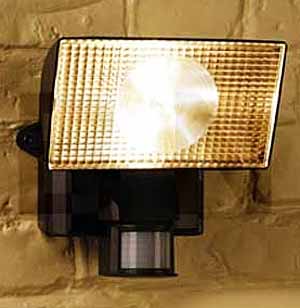
LIGHTING - Good lighting can deter a thief. Think of having external security light with infra-red sensor that switches the light on for a few moments when it detects movement in its range.
HOME AND AWAY - Don't tempt the thief - keep all valuable items out of sight. Don't advertise your absence when you're on holiday, or even when out at work or shopping or at home sleeping. Most burglars will only tackle an unoccupied house. Good quality Safes are now affordable.
HOME INSURANCE - Insurance will relieve you of the financial worry of replacing stolen goods and many insurance companies offer reduced premiums for people with good home security. Under Maintenance.
CALL US TODAY 07786234207

Security Lighting Systems
Security Lighting For Your Home and Business
Security lighting can be used in residential, commercial and industrial settings. Security lighting, one of the most common types of outdoor security, is an effective deterrent in preventing crime and intrusions.
An Intruder intending to enter your premises does not like two things – NOISE and LIGHT.
To increase your security, you can install security lighting from the very simple single floodlight with a built-in Infra-red Sensor to a professional Security Lighting System, which can be controlled and switched from inside the building.
The system can be designed to allow the area around the building to be divided into separate individually activated zones.
The security lighting can also be used in conjunction with Closed Circuit Television cameras, to record any unusual activity.
A1 SAS security liverpool use equipment in our Security Lighting Systems from the leading manufacturers, who specialise in this area of building Protection.
MANUFACTURERS,
HONEYWELL,
GJD LIGHTING,
TEXECOM,
FREIDLAND,
CALL TODAY FOR A FREE ESTIMATE ON 0151 920 4612 AND 07786234207
SOLAR POWERED LIGHTING
COST EFFECTIVE SECURIY LIHTING
Solar Security Lighting.
Solar security lights are an important advancement in home security as well as safety. Solar security lights do not require a need for tangled wires that would drain unnecessary energy or one's pocketbook.
Solar Security Lights
Energy-saving & effective deterrents
against thieves and criminals.
Solar security lights provide a well lit path through one's yard that easily illuminates anything else that may be hiding in the yard.
Using a set of rechargeable batteries, solar security lights are charged throughout the course of the day when the sun's UV rays come into contact with the photovoltaic cells that make up the solar unit.
Solar security lights may not only be set to automatically come on at dusk, but some of the newer models can come with a remote system to allow you to turn them off at night if you wish.
There are also larger solar security light systems that are great for use in areas that the standard path style light cannot reach. These larger solar security lights usually come with halogen bulbs as well as a passive infrared sensor, which is sometimes called a PIR.
The PIR can then be set for a highly adjustable choice of angles as well as distances in order to control how and when the solar security light is activated. But, the major down side of these kinds of solar security lights is due to their high energy consuming bulb, which usually average 50 to 60 illuminations on a single battery recharge.
The solar security light that has become the most popular next to the path have to be the floodlight. The solar-powered floodlight, which utilizes a halogen bulb, is not just for walkways but also for garages and driveways as well as the backyard sheds. Solar security lights are specially designed to turn on automatically when it detects any motion during the night.
The batteries that are used with solar security sights are usually a sealed lead acid battery, similar to that of a car's battery but on a much smaller scale. These batteries allow for multiple discharges throughout the night but do not require a full discharge before recharging the battery again. There are also many solar security lights that utilize a Nickel Metal Hydride or NiMH battery instead of the lead acid battery.
Solar security lights are a cost-effective addition to any home. Their wireless installation make it a cinch for even the most timid home improvement enthusiast and they can be used anywhere around the house that needs a late night light shining into the dark.
Since some models of solar security lights also some with an external solar collector, you can utilize the lights inside the house as well as over shaded areas of your yard. This is done by mounting the light in one location and the solar panel in another location. The two elements could be 50 feet away from each other while still receiving an ample amount of sunlight necessary to recharge the solar security light's batteries.
COMMONLY USED SECURITY TERMS
CPO Association of Chief Police Officers. The ACPO approve the usage of certain alarm components, usually for high security/monitored installations.
Active IR Active Infra-red detectors, as opposed to Passive Infra-red (PIR), comprise an IR transmitter and receiver and are usually used to provide a long curtain coverage e.g. the perimeter of a compound.
Alarm Receiving Centre (ARC) Also known as Central Station. An ARC is a secure location which monitors signals from alarm systems connected to it. The ARC uses Confirmed Detection to verify that an alarm has been generated by an intruder (audio - listening device on premises, visual - CCTV on premises, Sequential Confirmation) and on confirmation will contact the Police.
Auto-dialler A device connected to the alarm control panel which dials up to 4 pre-programmed telephone nuimbers and delivers pre-recorded voice (with some systems text as well) messages. On control panels with a suitable communicator output the type of alarm (intruder, fire, Personal attack) can be differentiated and a specific message for the type of alarm can be sent. Other sensors may also be connected to the autodialler, e.g. a temperature sensor in a cold storage room to send a message that the temperature has risen above a preset value.
Back-up Battery A rechargeable battery used to power burglar and Fire alarms in the event of mains power failure. All systems should be fitted with a battery of suitable capacity, which should maintain the system in a quiescent (non-alarm) state for at least 8 hours. For example a burglar alarm system comprising a Control Panel (70mA) 8 x PIRs (15mA x 8 = 120mA) and an external Sounder (30mA) uses a total power of 220mA, thus a 12v battery rated at 2.1Ah will maintain the system for 9.5 hours if the battery is in perfect condition. Batteries remain in reasonable condition for up to 3 years but they should be checked annually (voltage should be 13v - 13.6v)
Bell Formerly used in burglar alarm installations, still used in some fire alarm installations - output approx. 90dB
Bellbox A housing, usually external used to enclose audio (formerly a bell but now Piezo Sounder(s)), visual (Strobe) or nothing (Decoy or Dummy).
Blank End-station A Blank End-station is an alarm control panel without an on-board keypad. All programming and setting/unsetting is carried out at one or more Remote Keypads (RKPs). Blank End-stations can be hidden from view (attic etc.).
Break-Glass Detector An intruder alarm detector comprising a microphone and signal processor to identify the unique sound frequencies of breaking glass,
BS4737 British Standards for design, installation and maintenance of intruder alarm systems
BS5979 British Standards for construction and working practices of an ARC
BS6799 British Standards for wireless intruder alarm systems
Cable (alarm) Wired Alarm systems use multi-core cable to monitor the detectors and to connect to sounders. Cable is available in 4, 6, 8, and 12 core versions and in white or brown. Non-powered detectors (e.g. magnetic contacts) require a minimum of 4 cores (2 for alarm, 2 for tamper), Powered detectors (e.g. PIRs, vibration detectors) require a minimum of 6 cores (2 for alarm, 2 for tamper, 2 for 12v power). Self Actuating Bells (SABs) and SCBs usually require 5 cores of a 6 core cable. More than one detector may be connected to the same cable in this case the alarm circuit and tamper circuit are each connected in series (daisy chained) such that any detector on the circuit will cause the circuit to go open corcuit. The power supply to powered detectors is connected in parallel.
CCTV Closed Circuit Television
Decoy Sounder/Bellbox An empty external sounder enclosure to provides a visual deterrent. Most sounder manufacturers supply matching decoys for their live sounders. Can be fitted with battery operated flashing LEDs
Detector A device which sends a signal to the control panel indicating a change of state (Normally Closed[NC] to Open circuit or Normally Open [NO] to Closed circuit).
Digital Communicator A device connected to the Control Panel which sends a digitised signal to the Alarm Receiving Centre
Double Knock Some Control Panels and Detectors can be programmed to only alarm if two alarm signals are received within a certain time. This can significantly reduce the occurrance of false alarms.
Dual Technology Detector A detector with two different types of detection within the same housing. The mosst common type uses PIR and Microwave technology such that both technologies have to be triggered to produce an alarm condition. This greatly reduces the occurrance of false alarms.
Dummy Sounder/Bellbox An empty external sounder enclosure to provide a visual deterrent. Most sounder manufacturers supply matching decoys for their live sounders. Can be fitted with battery operated flashing LEDs
Duress Code An alarm unset code which unsets the alarm system as normal but sends a personal attack code to the Alarm receiving centre.
E/E Zone A zone on the Control Panel to which detectors on the route in and out of the premises are connected. Detectors on this route do not cause an alarm until a user programmed time has elapsed. See also Inhibited/intermediate
EN501-31 Standards for design, installation and maintenance of intruder alarm systems
Exit Terminator A device fitted outside the alarmed area used to set the alarm system.
Extension Speakers Most control panels have terminals for fitting extension speakers or internal piezo sounders
Full Set Most Alarm control panels can be programmed for Full and Part settings. Full set normally alarms all the active zones of the system. part set can be programmed to omit specified zones. The function of the zones can also be changed. For example; a house alarm could be programmed to protect the ground floor and first floor and have the front door as the E/E zone. In Part set only the ground floor is alarmed and the front door is set to Immediate instead of E/E and the PIR at the bottom of the stairs set to E/E.
Inertia Detector Also known as Vibration/shock sensors. Detectors which detect and process vibrations typical of an intruder trying to forcibly open a door or window (or even a wall!)
Intelligent Device system (iD) iD systems use miniature silicon chips (Biscuits) which are easily fitted into any standard detector at the time of installation. Each biscuit uniquely identifies the detector it is connected to, thereby allowing up to 30 detectors to be connected to a single cable.
IP An IP (Ingress Protection) number is used to specify the environmental protection of enclosures around electronic equipment. These ratings are determined by specific tests. The IP (Ingress Protection) number is composed of two numbers, the first referring to the protection against solid objects and the second against liquids. The higher the number the better the protection.
LCD Liquid Crystal Display - these allow the information on Control Panels and Remote Keypads (RKPs) to be displayed alphanumerically
LED Light Emitting Diode
Magnetic Contact A detector comprising a magnetically operated reed switch and a separate magnet. Usually used on doors and windows where the magnet is fitted to the opening door or window and the switsh on the fixed frame such that when the opening door or window is closed the magnet is in close proximity to the switch such that the switch closes and the circuit connected to the switch is closed, This is known as a Normally Closed (NC) detector
Master Code The administrators code for the system which allows all available programming functions
Monitored Alarm An alarm system usually monitored by an ARC.
NACOSS National Approval Council for Security Systems.
NICEIC National Inspection Council for Electrical Installation Contracting
NSI National Security Inspectorate
Non-Volatile Memory (NVM) This is a memory chip in the Control Panel which remembers the programmed alarm settings when all power is removed. The NVM can usually be reset to Factory Default settings.
Panic ALarm (PA) Also known as Personal Attack is usually a button which when pressed causes a full alarm condition regardless of whether or not the alarm system is set/unset. This may be programmed to cause a silent alarm if the system is monitored, thus having the same effect as Duress code.
Part Set Most Alarm control panels can be programmed for Full and Part settings. Full set normally alarms all the active zones of the system. Part set can be programmed to omit specified zones. The function of the zones can also be changed. For example; a house alarm could be programmed to protect the ground floor and first floor and have the front door as the E/E zone. In Part set only the ground floor is alarmed and the front door is set to Immediate instead of E/E and the PIR at the bottom of the stairs set to E/E.
Passive Infra-red (PIR) Detector This detector 'sees' the temperature of the area it is covering. A lens at the front of the detector splits the area 'seen' into several zones, when the temperature 'seen' in adjacent zones changes at a certain rate then an alarm is triggered.
Pet Immune (PIR) Detector This type of detector is similar to a standard PIR but has a reduced sensitivity. Typically not detecting animals weighing up to 80 lbs. Also available in Dual Technology versions.
Pet Lens A lens fitted to a PIR which alters the beam pattern such that the detection zone is raised a certain height above the floor usually okay for dogs, but not necessarily so for cats.
Pulse Count This facility is available on most PIRs and is similar to the Double Knock (see above) in that the detector has to detect 2 or 3 alarm events within a specific time before it creates an alarm state.
Push-to-set A terminal on the control panel which allows a button outside the alarmed area to be pushed to set the alarm.
Power Supply Unit (PSU) All Control Panels have a PSU usually rated at 1.0 Amp. This is normally sufficient to supply around 15 powered detectors (PIRs, Vibration Detectors) and two sounders. If extra power is required a separate PSU can be added.
QUAD PIR A PIR detector with two heat sensors
Remote Keypad {RKP) A keypad located remotely from the control panel used to set/unset/programme the alarm. The RKP can be connected to a Blank End-station (Controlpanel without on-board keypad) or a stand-alaone control panel. Most control panels allow between 4 and 6 RKPs to be connected.
Security Grades A system under which alarm components are graded (1 to 4) according to the level of protection they afford.
Self Activating Bell (SAB) The 'bell' is a legacy term but the function is the same. Most external sounder units are SAB devices, that is that they can operate independently of the control panel. They contain a rechargeable battery and charging circuit. In non-alarm condition the battery is charged from the control panel and the LEDs (if fitted) indicate a healthy state. In alarm condition the sounder is triggered (and strobe if fitted) and powered by the control panels power supply. If the cable to the sounder is cut the sounder will still operate using its internal battery.
Self Contained Bell (SCB) This is similar to the above except that in alarm condition the power is derived from its internal battery. Some sounder units can be set to operate in ether SAB or SCB mode. If the amount of power from the panel is insufficient to operate the sounder then it can be set to SCB mode. This is useful when fitting multiple sounder units
Verification The means of verifying that an intrusion has taken place. Can be via audio, visual or sequential means.
Vibration/shock Detector Detectors which detect and process vibrations typical of an intruder trying to forcibly open a door or window (or even a wall!)
Zone A typical Control Panel will usually have 8 zones and in the majority of cases these are individually programmable as
Entry/Exit - detectors on this zone do not cause an alarm if they are triggered within a user set time. Some panels have a final door set which sets the alarm as soon as the final detector goes to closed circuit.
Inhibited or Intermediate - detectors on this zone will not alarm within the Exit time (as set on the E/E zone), however once the alarm is set they operate in immediate mode unless the entry into the premises is through the E/E zone.
Immediate - detectors on this zone trigger an alarm immediately.
Fire - some control panels have a dedicated fire zone and on some any zone is programmable as fire. The fire zone is designed for connection of smoke detectors. The zone operates 24hrs (i.e. whether the alarm is set or unset). The sounder(s) usually have a distinctive sound when triggered by this zone.
Tamper - some control panels have a dedicated tamper zone and on some any zone is programmable as tamper. The zone operates 24hr (i.e. whether the alarm is set or unset) however when the alarm is unset only the internal sounder is activated, when the alarm is set both internal and external sounders are activated.
Personal Attack (PA) - some control panels have a dedicated PA zone and on some any zone is programmable as PA The zone operates 24hr (i.e. whether the alarm is set or unset). Both internal and external sounders are activated. The zone is designed for the connection of PA buttons.
Double Knock - some control panels can have a zone programmed to only alarm if two alarm signals are received within a certain time. This can significantly reduce the occurrance of false alarms
CALL TODAY FOR A QUOTATION ON 01519204612
SECURITY GRADES EXPLAINED
CALL TODAY FOR ADVICE ON 01519204612
Introduction
From the 01/10/2005, the existing British Standards (BS4737, BS7042 and BS6799) have been withdrawn and replaced by the new European Standards BSEN 50131. The European Standards are not be retrospective any systems installed to British Standards will still be maintained to that standard.
The European Standards rely heavily on risk assessment to specify the equipment and system requirements. The risk assessments are banded into grades based on the type of risk and the effort an intruder might be prepared to use in a burglary.
European Intruder Alarm Standards.
Four Grades of alarm system exist, based on increasing levels of resilience against attack by
intruders with anticipated levels of knowledge and tools.
Grade 1: Intruders expected to have little knowledge and limited tools. Alarm is suitable for a
low risk
Grade 2: Intruders expected to have limited knowledge and some tools. Alarm is suitable for
a low to medium risk
Grade 3: Intruders expected to have knowledge and full range of tools. Alarm is suitable for
medium to high risk.
Grade 4: Intruders expected to have sophisticated knowledge and tools. Alarm is suitable for
a high risk.
Alarm equipment is marked as being suitable for use at a particular grade. Whilst installers
will generally use equipment of the same grade in each system, it may sometimes be
appropriate to mix equipment of differing grades, in which case the official Grade of the whole
alarm system is that of the lowest graded piece of equipment used with in it.
There is still little alarm equipment available for grade 4 systems and therefore Alarm
installers will use some Grade 3 equipment. However Grade 4 signalling equipment is
available and should be installed with all alarm systems in medium to high risk premises e.g.
Jewellers.
The Association of British Insurers (ABI) stopped insurers as a group deciding the grade of
alarms because the Office of Fair Trading (OFT) considered it un-competitive with the result
that alarm companies decide the alarm grade for the risk. In their quest for business it’s
possible for the installing company to recommend a lower grade alarm. Although in theory
grade 2 is for low to medium risk and grade 3 for high risk e.g. jewelers, installers quite often
recommend Grade 2 equipment.
Please note that in general it is required by insurers that Jewellers install a grade 3 system
with Grade 4 signalling. No matter what grade alarm system is installed, Grade 4 signalling is
required.
Grading of Detection and control systems
Apart from increasing control panel event memories and levels of recommended detection,
the key difference between Grades 2, 3 and 4 is that movement sensors at Grade 3 must be
able to detect masking, i.e. something being placed over the sensor lens. At Grade 4
movement sensors should be able to detect range reduction, i.e. something blocking part of
the detectors field of view.
Grading of Signalling Systems
Each signalling Grade has a subset of options showing acceptable combinations of signalling,
e.g. an audible siren and/or a link to an Alarm Receiving Centre (ARC).
Those likely to be used in the UK are:-
Grade 2 - Option X Siren at premises
Grade 2 - Option B Siren + Single link to ARC
Grade 2 - Option C Two links to ARC
Grade 2 - Option D Single link to ARC
Grade 3 - Option B Siren + Single link to ARC
Grade 3 - Option C Two links to ARC
Grade 3 - Option D Single link to ARC
Grade 4 – Option B/C/D Options as Grade 3 above
The performance of the link to the ARC varies between grades. For example, Grade 2 Option
B signalling must enable an ARC to be notified of signalling failure with in 25 hours. Grade 3
Option B must notify the ARC of signalling failure within 5 hours. Grade 4 Option B must
notify the ARC of signalling failure within 3 minutes.
Recent changes in the Association of Chief Police Officers (ACPO) policy requirements
states that the police will respond to a security system activation either as a result of a
confirmed activation through a remotely monitored security system i.e. that two
separate signalling systems using different signalling paths must be provided if the
police are expected to attend a line cut. It is therefore required that dual path
signalling is installed.
Grading of maintenance
Maintenance requirements are:-
Grade 2 - Option X 1 site visit Per annum
Grade 2&3 - Option B/C/D 2 visits per annum
OR 1 site visit and 1 remote check
Grade 4 - Option B/C/D 2 site visits per annum.
Systems that are designed to generate confirmed alarm conditions are further subject to British
Standards Institute document DD 243. These two documents establish minimum standards for
alarm systems in buildings (whether commercial or domestic).
They do not however, adequately address all of the features that insurers normally require of an
alarm which is intended to protect commercial premises, and it is therefore necessary to give
additional specification requirements to alarm installers when purchasing a new system. Please
therefore ensure that you pass a copy of the “Risk Management Guide – Alarm Specification” to
your intruder alarm company.
Before installing a new Intruder Alarm System please let us see a copy of the proposed specification so we can confirm it meets Insurer’s requirements.
System wide, products of different Grades can be mixed within the system, however the overall grade of the system will be that of the lowest grade component used. .

FIND US IN THE YELLOW PAGES
CALL US TODAY ON 01519204612
home |
Intruder Alarms |
CCTV |
Alarms Maintenance |
Contact us
|